Between their first steps and their first sentences, children live in a world of pure observation. At 12 to 18 months, your toddler is a sensory scientist. They aren’t looking for complex rules, stories, or a room full of toys; they are busy answering one fundamental question: “What is this?”
If you want to end your day knowing you’ve done enough for your child’s development, forget the “busy work.” Focus on these three pillars of intentional presence.
1. The Power of Naming
Your toddler is absorbing language like a sponge, but they need clarity to process it.
- The Essential Action: Point and name. Not just “toy” or “thing,” but the real names of the world. “Whisk.” “Asparagus.” “Oak tree.”
- At Home: You don’t need flashcards for things that are already in your hands. When you are emptying the dishwasher or folding laundry, name the objects. Let them hold the cold spoon.
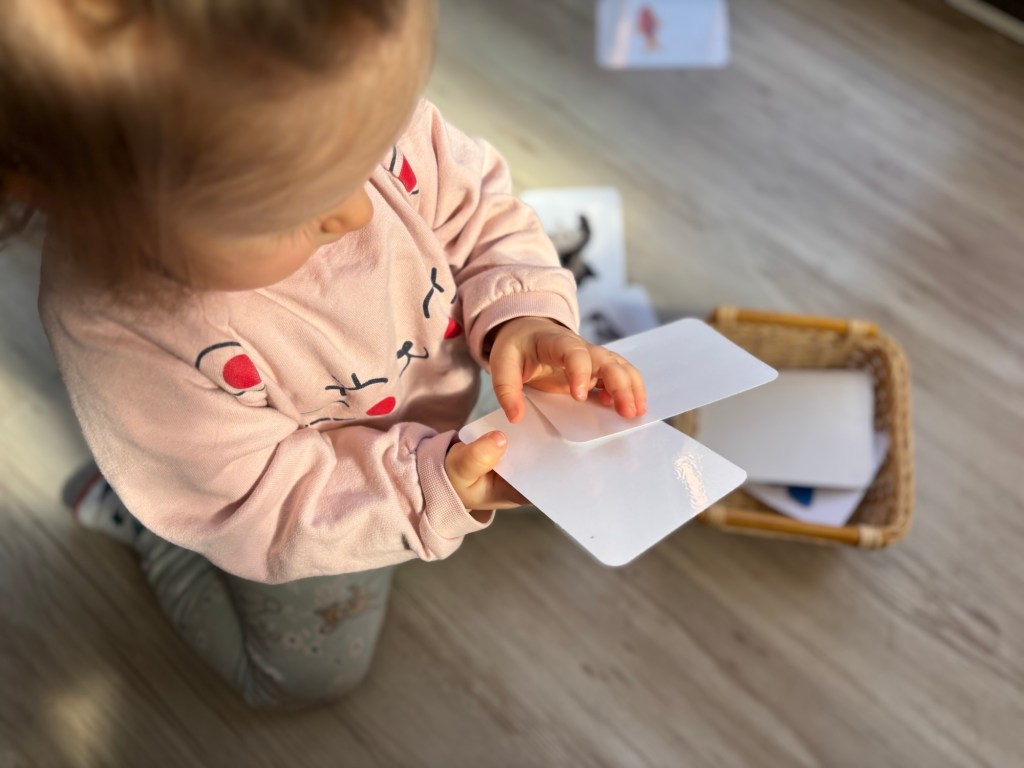
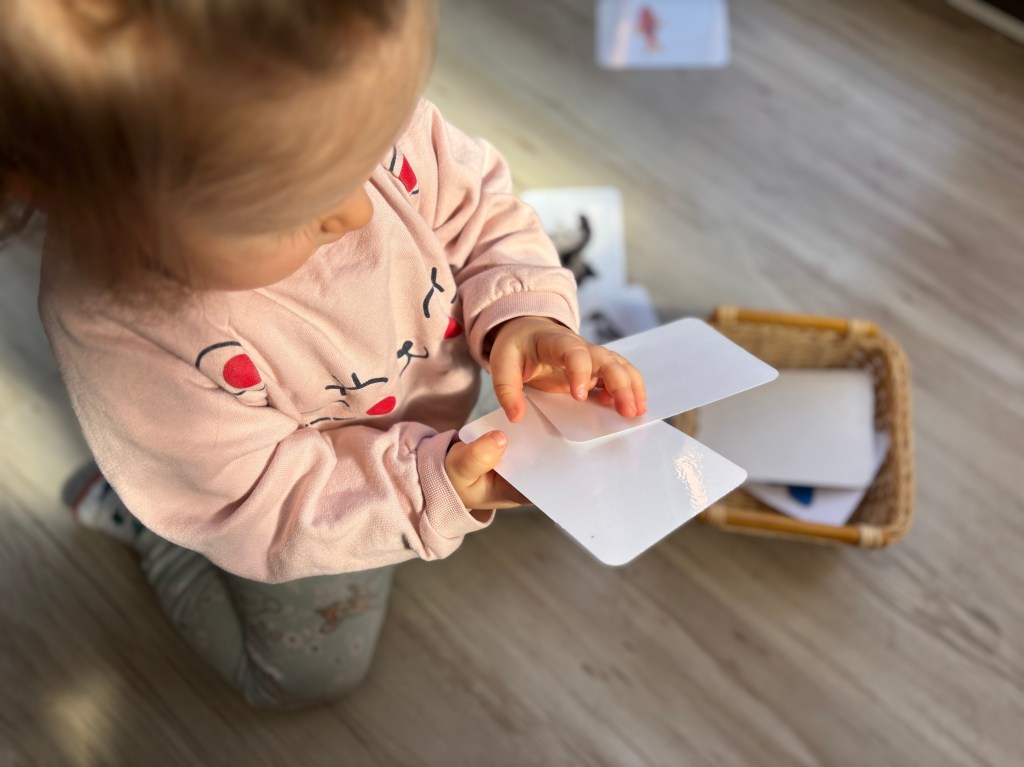
- Where a Tool Helps: For things you can’t hold safely or that aren’t in your house (like a blue jay or a tractor), a High-Quality Photo Card acts as a vital bridge. It allows them to study the image without the distraction of a busy background.
2. Visual Discrimination (The “Aha!” Moment)
This is the ability to see the small details that make things unique. It’s the foundation for all future logic and reading.
- The Essential Action: Slow down. When your child stops to look at a crack in the pavement or a speck of dust, wait with them.
- At Home: Create a “matching” moment with real objects. Set a real apple next to a real banana. That’s it. That is a brain-building activity.
- Where a Tool Helps: Once they understand the object, Matching Cards (pairing a real object to its photo) help their brain move from 3D reality to 2D abstraction. This is a massive cognitive leap that a simple card facilitates perfectly.
Dive deeper: Learn how to navigate the visual journey from reality to abstraction for every stage of development.
3. Predictability as Safety
At this age, “learning” only happens when a child feels safe. Safety for an Noticer comes from knowing what happens next.
- The Essential Action: Keep a steady rhythm. You don’t need a printed schedule for them to look at yet—you just need to be the rhythm. Same sequence, every day.
- At Home: Narrate your transitions. “First we put on socks, then we put on shoes.” Your voice is their most important guide. (If you find yourself overwhelmed and losing your own rhythm, only then consider a Visual Daily Rhythm as a tool for you to stay on track).
Did I do enough today?
If you feel the pressure of “educational activities” creeping in, come back to this checklist. You have done enough today if:
- You named a few things with their real, beautiful names.
- You waited for thirty seconds while they studied something “unimportant” like a leaf or a zipper.
- You maintained the rhythm, letting them know that after lunch comes the nap.
 done by krikri