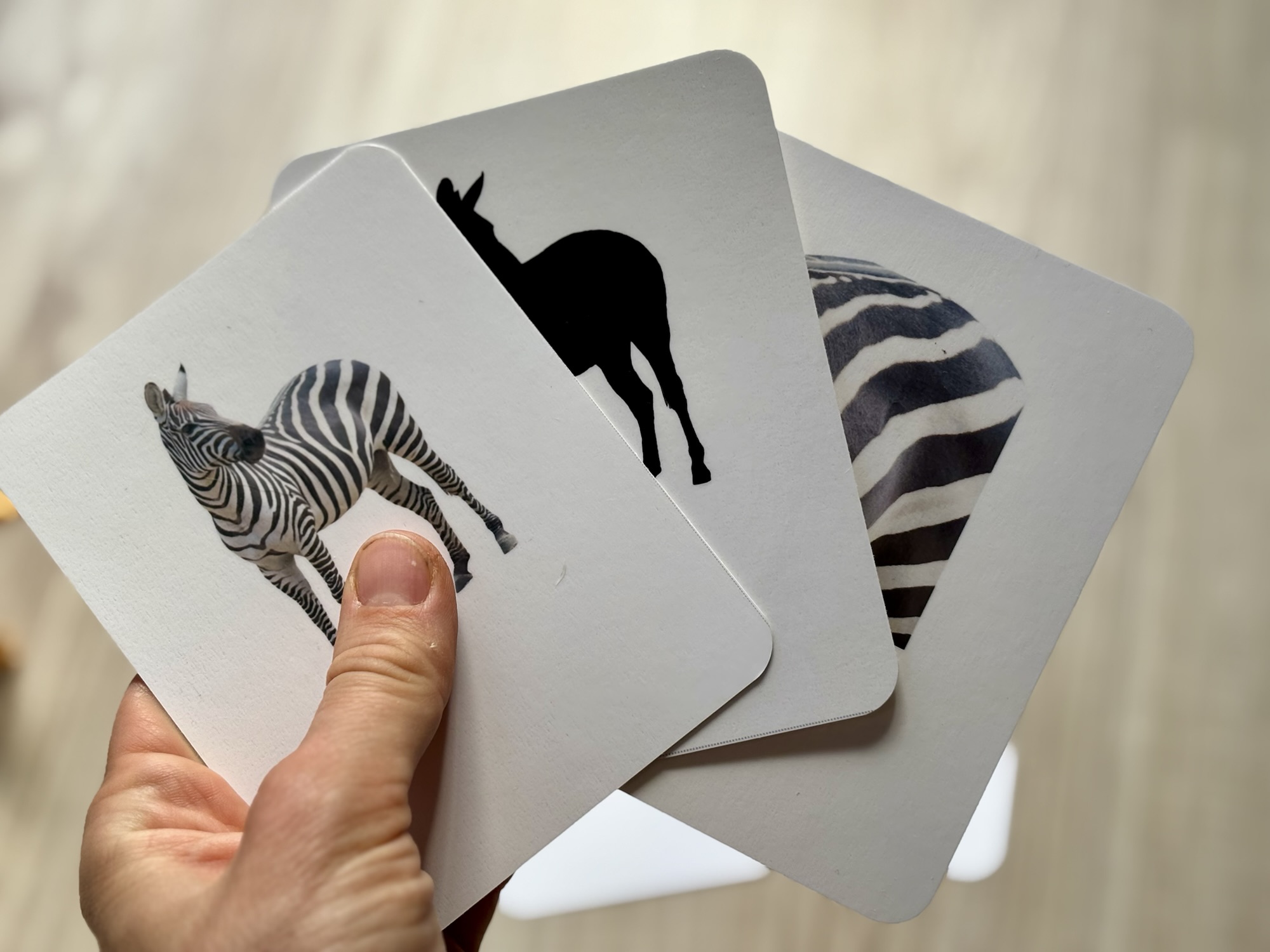
In the world of early childhood education, we often fall into the trap of “single-use” toys. We buy a puzzle for shape recognition, a book for animal sounds, and a game for matching shadows. Our homes become cluttered with fragments of learning, most of which lose their relevance within six months.
As a Learning Designer, I view toys differently. I look for The Growing Tool—an object that adapts its complexity to the child’s evolving cognitive architecture.
My Wild Animals Growing Set was born from this exact need. It’s not just a collection of 12 flashcards; it’s a four-stage system designed to bridge the gap between a 12-month-old “Noticer” and a 5-year-old “Researcher.”
Stage 1: The First Contact (12m+)
At twelve months, a child is learning how to hold the world. Most flashcards fail here because they are designed for adults. My cards feature a high-quality photograph centered in the upper half. Why? Because a toddler doesn’t know “up” from “down.” By leaving the bottom half white, I’ve created an intuitive grip zone. No matter how they grab it, their thumb won’t cover the subject.
At this stage, we aren’t “teaching” animals. We are simply naming the world. “This is a crocodile.” Simple. Pure. Uncluttered.
Stage 2: The 2D-to-3D Bridge (18m+)
This is where the magic of the “Growing Set” begins. By matching the photo to a physical figurine (like Safari Ltd. Toobs), we help the child build the abstraction bridge.
Moving from a 3D object to a 2D representation is a massive cognitive leap. Using real photographs instead of illustrations is crucial here—we want to provide the brain with accurate data, not a stylized version of it. It’s the difference between “playing” and “building a mental library of the real world.”
Stage 3: Developing the Analytical Eye (2y+)
Once the child masters the basic match, we introduce the Shadow and Detail cards.
- The Shadow: This forces the brain to ignore color and texture and focus purely on silhouette and form. It’s early geometry in disguise.
- The Detail: This is about micro-observation. “Where does this scale pattern belong?” It teaches the child to move their focus from the whole to the part, a skill essential for later reading and scientific inquiry.
Stage 4: The Researcher (3y–5y)
The set culminates with the Info Card. We move from “What is it?” to “How does it live?” By providing facts about habitats and diets, the cards become a spark for conversation and classification. Suddenly, your “toy” is a tool for biology, geography, and language development.
Pro-Tips for the Creative Parent (The Essentialist Shortcuts)
You don’t need a hundred toys; you need one tool used a hundred ways. Here are a few ways I use this set when I want to push the boundaries of “standard” play:
- The Scavenger Hunt: Hide the 3D figurines around the room. Give the child the Shadow card as their “clue.” They have to find the object that fits the shape.
- The Sensory Bin: Bury the Detail cards in a bin of sand or dried beans. As the child “digs” them up, they have to identify the animal based only on a patch of fur or skin.
- Habitat Sorting: Use a blue cloth (water) and a brown cloth (land). Ask the child to categorize the Info cards based on where the animals spend most of their time.
- The “Rule of Three” Challenge: Lay out three distinct Animal cards. Describe one using a fact from the Info card (e.g., “I am looking for someone who lives in swamps.”). See if the child can identify the correct card through elimination.
Context over Consumption
The goal of intentional parenting isn’t to provide the most toys, but to provide the most meaning. By choosing tools that grow, we reduce the noise in our homes and increase the depth of our children’s focus.
One set. Four years. Infinite “Aha!” moments.
Shop the Wild Animals Flashcards Set on Etsy.
Leave a Reply