The Popsicle Puzzle: Decoding a Viral Activity
I first saw this activity on Pinterest and, honestly, I dismissed it as “viral fluff”—one of those pretty activities that looks great in a 15-second reel but doesn’t actually offer much substance for the child.
However, after designing my own version for my daughter and watching her engage with it, I had to eat my words. What looks like a simple matching game is actually a high-level cognitive task. It’s a masterclass in visual analysis disguised as a summer treat.
What is the Popsicle Puzzle?
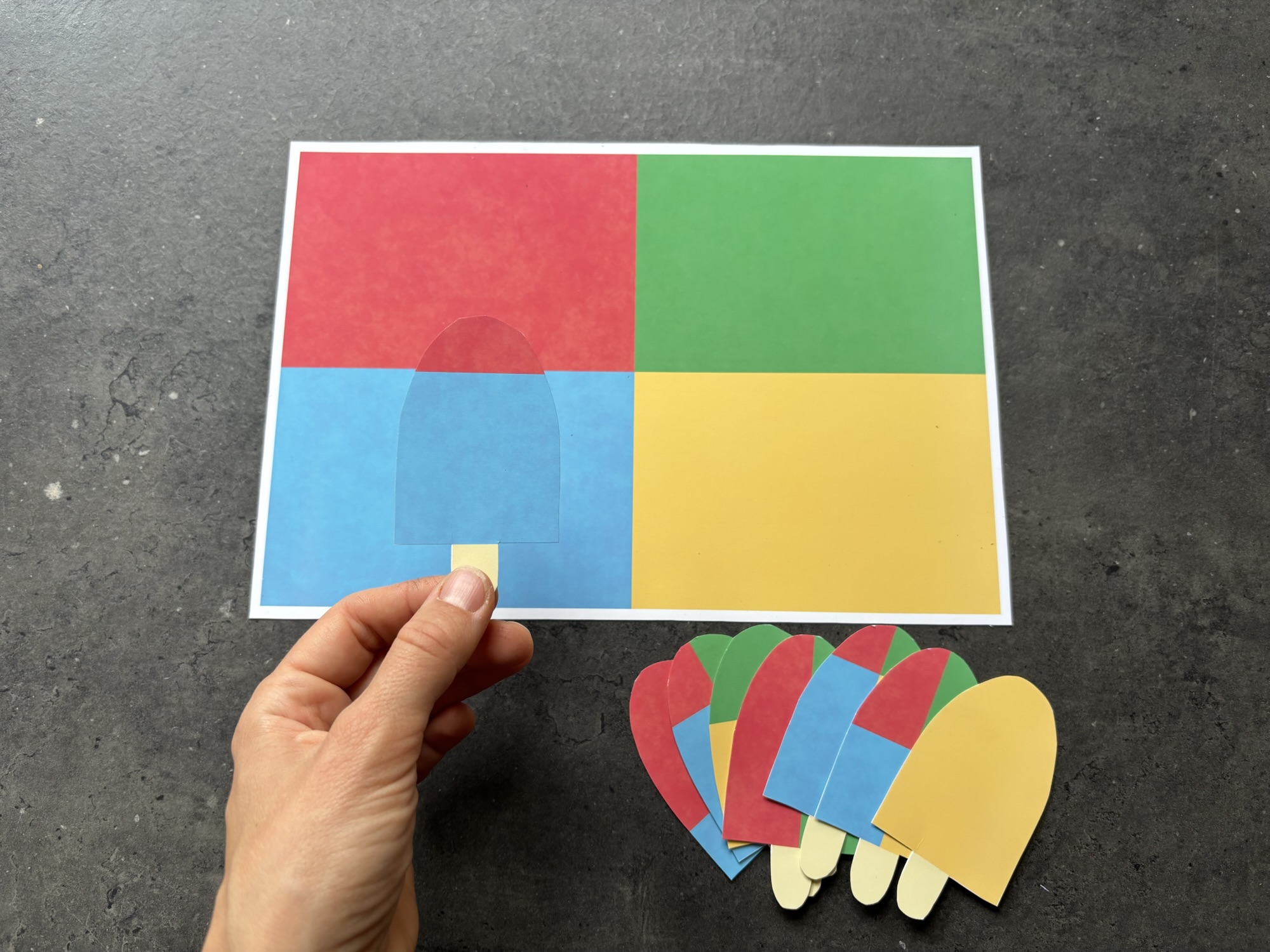
The setup is simple but deceptive. It consists of a Master Color Mat (image_2.png) with four quadrants (Red, Green, Blue, Yellow) and 8 unique popsicle cut-outs (image_3.png) featuring different patterns of those same colors.
The objective? The child must find the exact spot on the mat where the popsicle “disappears.”
The Cognitive Load: What it Develops
This isn’t just “matching colors.” It is a complex workout for the developing brain:
- Visual Discrimination: Identifying where one color boundary ends and another begins.
- Spatial Reasoning: Understanding that if the red part is at the top of the popsicle, it must align with the top half of the red square on the mat.
- Pre-Math Skills (Proportions): Recognizing how “much” of a color is present—which is a child’s very first introduction to the logic of fractions.
- Data Synthesis: Taking a complex, multi-colored object and breaking it down into logical parts to find its match.
The Invitation to Play: Montessori meets Coaching
How you present this determines the depth of the learning. I recommend setting this up as a clear Invitation to Play: the mat laid out flat with the popsicles in a small basket or tray to the side.
The Age Break (3.5 vs. 6 years old):
Where the complexity “breaks” depends on age and experience:
- The 3.5-Year-Old (Guided Coaching): At this age, the child might feel lost. They see the whole image but can’t yet deconstruct it. My daughter needed me to coach her through a “Color Audit.” I’d ask: “How many colors do you see? Is it a lot of red or just a little?” This coaching builds the analytical framework they don’t yet have.
- The 6-Year-Old (Independent Mission): By age 6, the “disappearing” mechanic is a fun challenge. They don’t need instructions; they need a mission. For them, it becomes a game of speed, precision, and independent problem-solving. They have already internalized the logic of proportions.
Professional Parental Coaching Tips:
If your child feels lost (common for ages 3–4), use my Color Audit method:
- Count the colors: “How many colors are on this popsicle?”
- Estimate the amount: “Is there more red or more blue?”
- The Mission: “Move it around until it disappears into the mat!”
The Design Detail: Texture and Printing
As a designer, I know that “flat” colors are a nightmare for home printers—they often come out streaky. I’ve overlaid a subtle icy texture on these files. Not only does it make the popsicles look more realistic, but it also masks printing imperfections. You don’t need expensive photo paper; these look professional on standard A4 or US Letter paper, saving you both ink and money.
Beyond the Match: The “One and Done” Antidote
I don’t design “one and done” activities. Once the matching is mastered, the set becomes a tool for:
- Mathematical Conversations: “Which popsicle is 50/50 red and green?” or “Can you find one that is only 1/4 yellow?”
- Sensory Vocabulary: Talking about flavors. “What flavor would the green part be? Lime? Apple? Mint?”
- Role-Play (The Ice Cream Shop): This is the ultimate extension. “Mom, how many popsicles do you want?” or “That will be five coins, please!” It turns a cognitive task into a social and transactional game.
Ready to start your own Popsicle Mission?
You don’t have to design it from scratch! I’ve prepared everything for you—from the icy texture to the targeted patterns. Grab the high-quality PDF, print it on standard paper, and watch your child’s logic skills melt into place.
👉 Get the Popsicle Pattern Matching Set on Etsy.
Leave a Reply